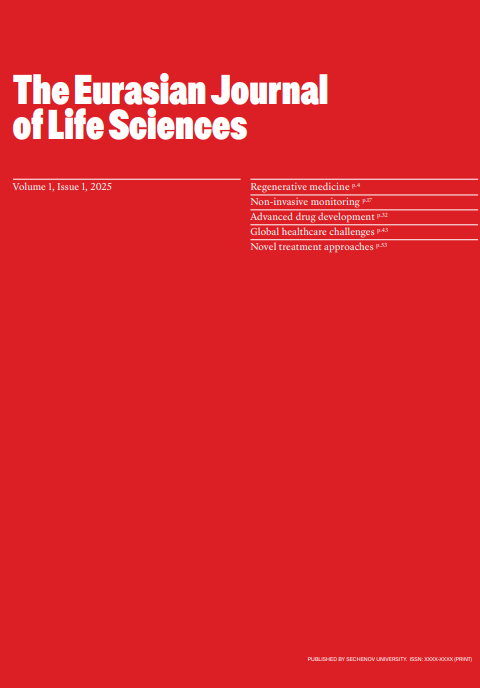
The Eurasian Journal of Life Sciences is an international scientific platform that brings together researchers, clinicians, and biomedical specialists to advance innovative solutions in healthcare and related disciplines.
The Journal's primary mission is to disseminate cutting-edge findings from both fundamental and applied research in life sciences and clinical medicine. It serves as a hub for translating advanced scientific knowledge into practical healthcare while fostering a collaborative environment for peer-level scientific communication and research team networking to facilitate joint project development.
The publication's scientific framework emphasizes pioneering achievements across clinical medicine and breakthrough life science research, including Personalized Medicine, Omics Technologies, Regenerative Medicine and other interdisciplinary fields.
A particular focus is placed on publishing research with practical clinical significance that promotes the implementation of innovative approaches in medical practice.
Current issue
Precision Oncology

Prostate cancer ranks among the most prevalent malignancies in men, with disease progression driven by sustained androgen receptor (AR) signaling. Androgen deprivation therapy (ADT), which suppresses androgen synthesis and AR activation, serves as the standard treatment for advanced disease. ADT modalities include surgical castration, gonadotropin-releasing hormone agonists/antagonists, anti-androgens, and androgen synthesis inhibitors. Despite initial efficacy, long-term ADT is frequently complicated by the emergence of castration-resistant prostate cancer (CRPC) and multi-system toxicities involving metabolic, cardiovascular, and skeletal systems. CRPC arises from AR reactivation via gene amplification, mutation, splice variants and crosstalk with oncogenic pathways. Contemporary treatment intensification combines ADT with next-generation AR inhibitors, chemotherapy, and immunotherapy. Predictive biomarkers such as AR variant 7 and homeobox B13 facilitate patient stratification and individualized treatment decisions. The aim of this review is to summarize the role of ADT in prostate cancer management, with particular emphasis on androgen metabolism, AR signaling, mechanisms of castration resistance, ADT-related complications, and emerging therapeutic strategies. Based on systematic literature retrieval from PubMed and Embase (2018–2025), this review synthesizes current knowledge on androgen metabolism, AR signaling, CRPC mechanisms, ADT-related complications, and emerging therapeutic strategies to optimize long-term outcomes.
Translational Pathophysiology

This review examines the asymmetric therapeutic relationship between myocardial contusion (MC) and myocardial infarction (MI). Although these two forms of myocardial injury arise from different initiating events, they converge across key secondary injury pathways, including inflammatory activation, oxidative stress, calcium dysregulation, cell death, fibrosis, and ventricular remodeling. Its aim is to clarify which elements of MI generate biologically portable hypotheses for MC, which remain clinically non-transferable, and how trauma reveals the contextual limits of canonical MI care. Evidence was retrieved from PubMed and CNKI primarily covering publications between January 2000 and January 2026 including experimental studies, clinical investigations, imaging studies, and guideline or consensus documents. The comparative literature indicates that the major divergence between MC and MI lies not in the mere presence of myocardial injury, but in the primary insult, the spatial organization of tissue damage, the logic of diagnostic interpretation, and the sequence of therapeutic decision-making. In this context, MI should be regarded not as a directly transferable treatment template for MC, but as a more mature source of mechanism-based hypotheses, particularly for the modulation of inflammatory amplification, oxidative injury, maladaptive remodeling, rhythm-risk surveillance, and biomarker-imaging integration. Conversely, MC is clinically informative less as a therapeutic analogue of MI than as a boundary condition that clarifies the dependence of myocardial injury management on etiology, bleeding risk, structural injury, and competing clinical priorities. Future research should prioritize trauma-specific phenotyping, multimodal diagnostic stratification, biomarker-imaging integration, and prospective evaluation of adjunctive targeted compatible with trauma care without delaying stabilization.
Fundamental Pharmacology

Introduction. Cardiac glycosides influence myocardial contractility via affecting Na⁺–Ca²⁺ exchange, but the isolated contribution of this mechanism remains poorly understood. The aim of this study was to determine the effects of strophanthin on cardiac contractions generated by the sodium-calcium exchange system alone.
Materials and methods. Experiments were performed on isolated hearts of Wistar laboratory rats perfused through the aorta using the Langendorff technique. Contractions were induced by perfusion with solutions of varying Na⁺ concentrations. Strophanthin in ampoules that was used as the studied pharmaceuticals was added to the perfusion medium at a final concentration up to 0.5 μmol/L. An equivalent volume of saline was administered in the control series.
Results. Experiments showed that the heart continued to contract and relax with each cycle of Na⁺–Ca²⁺exchange activation. However, the rate of contraction in the second repetition was 32 % lower. Strophanthin reduced contraction force in all three repetitions. Particularly significant disturbances were observed during the first stimulation — by 78 %. Muscle contractions and relaxation occurred under gradual increase in muscle tone during diastole. Given that strophanthin can reduce the activity of the Na⁺/K⁺-Adenosine Triphosphatase (Na⁺/K⁺-ATPase), our experiments clearly demonstrated the glycoside’s ability to increase intracellular sodium, and consequently, calcium concentrations. Repeated calcium efflux from cells via Na⁺–Ca²⁺exchange proved ineffective in the presence of strophanthin. The heart continued to experience calcium overload, which was reflected in the increased cardiac diastole stress.
Conclusion. When cardiac cells experience calcium ion overload, the final physiological effect influenced by strophanthin may be negative rather than positive.
Microbiomics and Metagenomics

Urinary tract infections (UTI), including recurrent cystitis, are usually interpreted in relation to dominant uropathogens. However, the microbial context of adjacent urogenital sites may also be relevant.
Aim. To evaluate the association between UTI and the microbiota of different parts of the urogenital tract in order to provide insights into disease pathogenesis and treatment.
Material and methods. The study included three groups: healthy volunteer group (n= 34); patients at risk of developing UTI (women with micronephrolithiasis and/or bacterial vaginosis; n = 16); and patients with a history of recurrent lower UTI (n = 100). Four types of biomaterial were used: first-pass and midstream urine samples, urethral and vaginal swabs. All samples were analyzed by multiplex real-time polymerase chain reaction reagent kits Femoflor®16 and BacScreen OM.
Results. Genomic DNA and total bacterial quantities increased while relative lactobacilli decreased in patients with a risk of UTI and in those with recurrent lower UTI. This was only the case in midstream and first-pass urine samples. Relative lactobacilli levels in the urethral and vaginal swabs were only slightly but statistically significantly reduced in patients with recurrent lower UTI. Facultative anaerobes predominated in urine samples of patients with a risk of UTI, while in patients with recurrent lower UTI an increase in both facultative and obligate anaerobes was observed.
Conclusion. Midstream and first-pass urine samples can reliably assess inflammation in the urogenital tract. No strict correlation was observed between the vaginal and urinary microbiota of patients with recurrent lower UTI, meaning that UTI do not necessarily affect the vaginal biotope.
Regenerative Medicine
In recent years, mesenchymal stromal cell (MSC) therapy has been widely studied as a major trend in medicine. However, it faces several clinical limitations, including immune reactions, tumor risks, and low homing efficiency. Consequently, cell-free strategies using MSC-derived extracellular vesicles (MSC-EV), particularly exosomes, are being studied as an increasingly recognized safer alternative. This mini-review aims to summarize current preclinical and early clinical evidence on the therapeutic potential of MSC-EV in female reproductive disorders, with a particular focus on premature ovarian insufficiency and thin endometrium, and to outline the key translational challenges to their clinical application. Preclinical and clinical data indicate that MSC-EV modify target tissue functions by transferring microRNA, proteins, and lipids. In chemotherapy-induced premature ovarian insufficiency models, MSC-EV restore folliculogenesis, increase anti-Müllerian hormone levels, and reduce granulosa cell apoptosis. In thin endometrium models, vesicles improve tissue regeneration and stimulate angiogenesis via the wingless-related integration site / β-catenin and mitogenactivated protein kinase / extracellular signal-regulated kinase (MAPK/ERK) pathway. Overall, MSC-EV serve as a viable cell-free option in reproductive medicine, though standardized protocols and robust clinical trials are still required.

ISSN 3033-6031 (Online)